
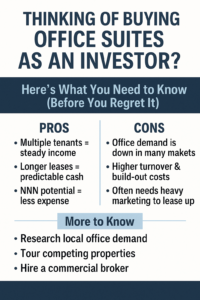
Thinking of Buying Office Suites as an Investor? Here’s What You Need to Know (Before You Regret It)
In the world of commercial real estate, office suites may seem like a smart move—multiple tenants, steady income, and professional appeal. But what many investors don’t realize is that office spaces can quickly become a money pit if you’re not strategic.
Here’s a breakdown of the real pros and cons of investing in office suites—along with why you need to do serious research before buying in.
📈 The Appeal: Why Investors Get Drawn In
✅ 1. Multiple Streams of Rental Income
Office suites allow for multiple tenants under one roof. This can stabilize cash flow and reduce risk if one tenant moves out.
✅ 2. Longer Lease Terms
Compared to residential leases, office tenants often sign 3–5 year leases, giving the investor more predictable income.
✅ 3. Triple Net (NNN) Lease Potential
Some office tenants cover property taxes, maintenance, and insurance—meaning fewer expenses for the landlord.
🚩 The Reality: Office Space Isn’t What It Used to Be
❌ 1. Post-COVID Market Shift
Remote work changed everything. Vacancy rates in many office markets have not recovered. Many businesses now want flex space, shared coworking, or hybrid arrangements—not traditional suites.
➡️ Real Example:
An investor in Sugar Land, TX bought an 8-office suite building in 2021 with only 2 tenants. By 2023, one downsized and the other terminated early. They’re now covering overhead out-of-pocket while trying to re-lease a space that isn’t in demand.
❌ 2. High Turnover and Tenant Improvement Costs
Office tenants often require custom build-outs—walls moved, flooring changed, signage added. You may have turnover costs between each lease.
📌 Tip: Make sure you negotiate tenant improvement (TI) contributions and budget for build-out delays.
❌ 3. CAM Fees Confusion and Hidden Costs
If your leases aren’t written correctly, you could be stuck paying for shared area maintenance, landscaping, repairs, and janitorial costs.
➡️ Red Flag:
Older office buildings with deferred maintenance = high future repair bills (especially HVAC, roofs, plumbing, ADA compliance).
⚖️ Pros vs. Cons Summary
| Pros | Cons |
|---|---|
| Multiple tenants = steady income | Office demand is down in many markets |
| Longer leases = predictable cash | Higher turnover & build-out costs |
| NNN potential = less expense | Often needs heavy marketing to lease up |
| Professional property appeal | Location and layout must be spot on |
🧠 Smart Investor Tips Before You Buy Office Space
✅ Research local office demand — not just “for sale” listings. What’s the vacancy rate?
✅ Tour competing properties — are they full or struggling to lease up?
✅ Know your tenant profile — law firm? CPA? Therapist? Each has different needs.
✅ Hire a commercial broker — not a residential agent. Office leasing is niche.
✅ Review the leases — are they full gross, NNN, or modified? What are the renewal rights?
🙋♀️ Final Thought: Office Space Isn’t Dead — But It’s Not for Every Investor
If you’re not ready to handle longer vacancies, marketing efforts, and upfront build-out costs, office suites may drain you before they pay you.
There are still smart office investments out there — but you have to underwrite them like a business, not just a building.
📲 Considering buying commercial space in Texas? I’ll help you analyze the real numbers and avoid risky buys. DM me “OFFICE ANALYSIS” and let’s run the numbers together.